Archive for the ‘Role-Playing Games’ Category
Paizo Publishing Announces new ‘Monster Codex’ for October
Wednesday, October 1st, 2014
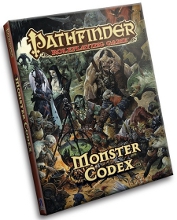
Paizo Publishing will release Monster Codex for the Pathfinder RPG on October 22nd, according to hobby news website ICv2.com. The 256-page hardcover will retail for $39.99. It will include chapters for 20 monsters:
- Boggard
- Bugbear
- Drow
- Duergar
- Fire giant
- Frost giant
- Ghoul
- Gnoll
- Goblin
- Hobgoblin
- Kobold
- Lizardfolk
- Ogre
- Orc
- Ratfolk
- Sahuagin
- Serpentfolk
- Troglodyte
- Troll
- Vampire
Each will include archetypes; over 10 new stat blocks; new rules like feats, spells, and magic items; advice and tips for game masters; and templates for customizing the monsters.
Interested in this product? Let your local Battleground Game & Hobbies know! Pre-order TODAY! Please don’t forget to let us know what you think in the comments below.

Tags: Board Game, Gamemaster, Monster Codex, New Release, Paizo Publishing, Pathfinder RPG, Role-playing Games, TableTop
Posted in Blog, Board Games, Featured Post, Role-Playing Games, Store Related | No Comments »

Trial to Decide ‘D&D’ Movie Rights Begins
Wednesday, September 24th, 2014

The trial to decide who owns the movie rights to Dungeons & Dragons opened in federal court in Los Angeles last week, with the two sides introducing their cases, as reported by Deadline and ICv2.com. The case, which began in May 2013, will turn on the question of whether Sweetpea Entertainment, which had the D&D movie license since TSR was an independent company (two acquisitions ago), satisfied the “use it or lose it” clause in the contract with its 2010 Syfy movie based on Book of Vile Darkness. Dungeons & Dragons owner (Hasbro subsidiary) Wizards of the Coast moved to suit when it looked like Sweetpea was going to make a film with Warner Bros. based on Chainmail, a precursor to D&D.
The judge ruled that Chainmail would have been an infringement had it been made, but in the meantime Sweetpea signed a multimillion dollar deal with Warners to make a new D&D movie this summer. Warners even kicked in around a million dollars for legal fees in the battle with Hasbro, which wants to make a movie with Universal, making this what Deadline called a “proxy war” between Warner Bros. and Universal.
It looked for a while like the two sides were moving toward a settlement, but talks apparently broke down and the case was scheduled for trial.
The two sides presented their positions on last Tuesday (i.e., Book of Vile Darkness is/was not a film sequel), and in the process got in an exchange about Hasbro/Wizards of the Coast’s plans for the property if it prevailed. Hasbro wants the rights back so it can “sell it to their new best buddy, Universal,” Sweetpea’s attorney argued; but “Hasbro has no agreement with Universal,” Hasbro’s attorney replied. That’s surprising, given that Hasbro said back in 2013 that it had a D&D movie set up at Universal with Chris Morgan to direct. Hasbro does have an umbrella deal with Universal.
Tags: D&D, Dungeons & Dragons, Hasbro, Movie RIghts, Sweetpea Entertainment, Trial, tsr, Wizards of the Coast
Posted in Blog, Board Games, Dungeons & Dragons, Featured Post, Role-Playing Games | No Comments »
Wizards of the Coast Announces Delay to ‘D&D: Dungeon Master’s Guide’
Monday, September 22nd, 2014
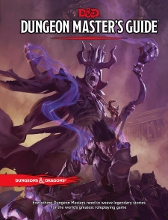
After making the dates on most of its long-planned rollout of the new edition of Dungeons and Dragons, Wizards of the Coast has announced that the last of the first range of releases will be delayed, as first reported by ICv2.com. Dungeons & Dragons: Dungeon Master’s Guide, originally planned for November release, will now ship in December.
The delay is blamed on “an entire additional cycle of design and editing to ensure that the books were as close to perfect as humanly possible” introduced with this new edition of the game. While this effort is touted as a boon for the quality of the Player’s Handbook and Monster Manual, which are releasing on schedule, it has pushed the production schedule back on the Dungeon Master’s Guide. For stores participating in WotC’s early release program, the book with have an on sale date of November 28th, with general release following on December 9th.
Tags: 5th edition, Book, D&D, DM Guide, Dungeon Masters Guide, Dungeons & Dragons, Next, RPG, Wizards of the Coast
Posted in Blog, Board Games, Dungeons & Dragons, Featured Post, Role-Playing Games, Store Related | 1 Comment »
Paizo Publishing Announces February 2015 Releases
Monday, September 15th, 2014
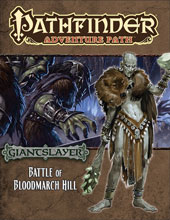
Paizo Publishing has announced its Pathfinder RPG releases for the month of February 2015, first reported by ICv2.com, which is the beginning of a new Adventure Path series: Giantslayer. Releases include the first adventure, a new campaign setting book, an adventure “toolbox,” and a map pack.
The Battle of Bloodmarch Hill launches the new six-part Giantslayer Adventure Path. In this adventure, players must defend a human settlement besieged by orcs while uncovering the truth behind a mysterious death. The adventure is designed for first level characters, and includes information on the giants of Golarion, new game mechanics for giants, and a new Pathfinder’s Journal. The adventure is compatible with the Pathfinder RPG and the Open Game License.
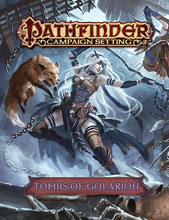
The new Pathfinder Campaign Setting: Tombs of Golarion presents a number of deadly dungeons and tombs for the Pathfinder game world. The 64-page softcover book includes a number of adventures including new monsters, traps, and treasures, as well as suggestions for game masters who want to include them in their own campaigns.
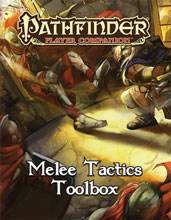
The Pathfinder Player Companion: Melee Tactics Toolbox will be a 32-page softcover book with new rules and game materials designed to enhance melee combat in the game. This book was written with the player in mind, designed to appeal to them rather than gamemasters. MSRP is $12.99.
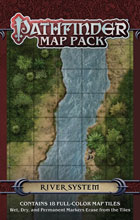
The last of Paizo’s planned quartet for February will be the Pathfinder Map Pack: River System. Designed to work with thePathfinder Flip-Mat: Basic Terrain Multi-Packand other grassy flip-mats, this set includes 18 full-color map tiles illustrated by Jason Engle. The tiles can be used to create a variety of river scenes, and have a special coating that allows wet, dry, and permanent markers to be used and erased. This will be the 54th Map Pack game accessory.
What do you think of these new offerings from Paizo Publishing? Does Pathfinder have what it takes to stand up to D&D Next? Let us know what you think!
Tags: ICv2, New Release, Paizo Publishing, pathfinder, Role-playing Games, RPG
Posted in Blog, Board Games, Featured Post, Role-Playing Games, Store Related | No Comments »
D&D Next Player’s Handbook: Initial Reaction by Sam Pearson
Tuesday, August 12th, 2014
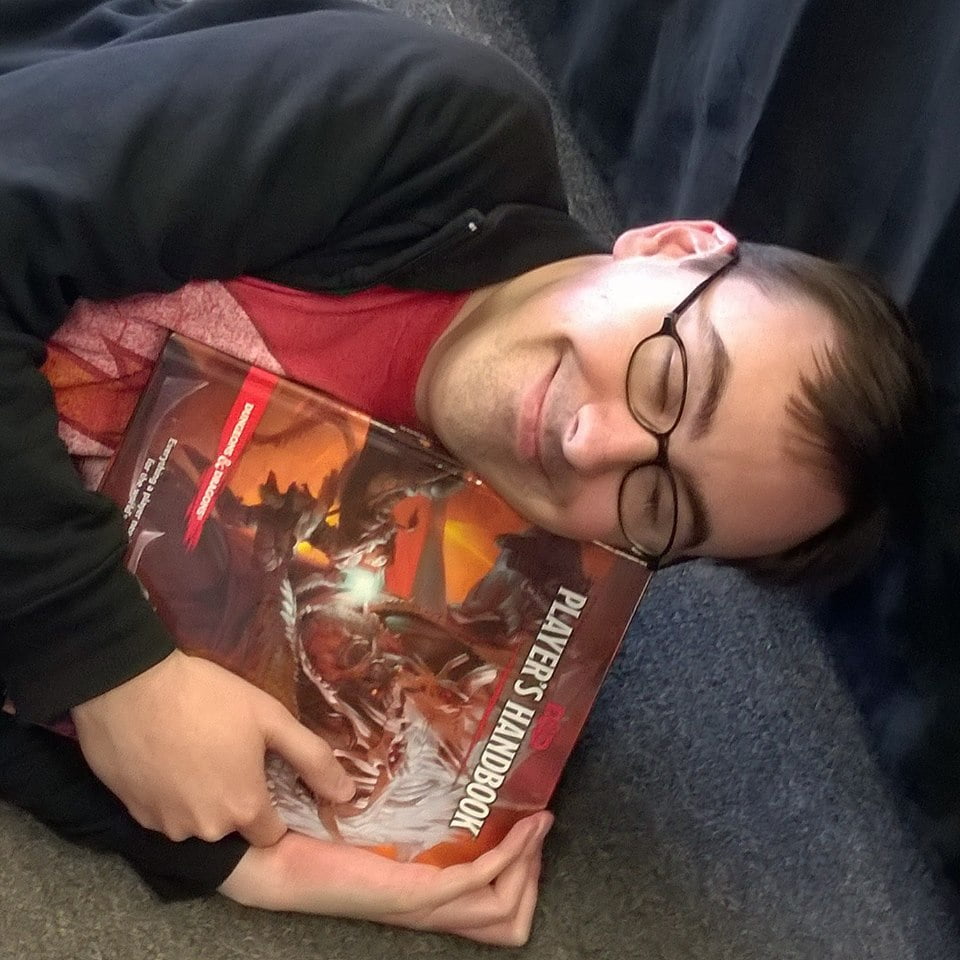
As many of you might know, I get excited about things. That’s kind of my job. But even I wasn’t prepared for what the 5th edition Player’s Handbook for Dungeons & Dragons did to me. Never before have I been such a roiling vortex of anticipation, wringing Twitter dry for each precious drop of information leading up to the release. You could have held a match to me, and it would have ignited. I was being held back from joy by the cruel, unrelenting slowness of time.
The book is out. I’m better now.
So let’s take a look at what patience and agony have bestowed upon us. Let’s see the PHB!
The Look
The first thing you’ll notice about the new Player’s Handbook is the art. You can’t escape it; it’s glorious. From the first glimpse of King Snurre’s rage on the front cover, to the paradigm-shattering sword-and-board fighter on page 148 (seriously, look it up), to page 191’s epic confrontation, the art draws you in and holds you. The style is unique, and every image evokes a whole universe of stories. Do yourself a favor and just page through once to look at the pretty pictures. Even if you’re a die-hard rules fan, it’s time well spent.
The Rules
Okay, this is the big one. I’ve heard the question a lot over the past year: “How do the new rules stack up?” The answer is: amazingly well. Gone are the restrictions of 4e, limiting players to a short list of powers and a gridded combat area. Gone is the arms race of 3.5, with players quickly outpacing any challenge the DM might be able to conjure. Derek calls 5e the best edition, and I agree. Let’s talk about why.
First, it’s easy. The core mechanic revolves around ability checks: roll a d20 and add a modifier from one of the six ability scores. That’s familiar ground for most D&D players, and takes five seconds to explain to anyone just starting with the game. There’s also a mechanic called advantage/disadvantage. Say you make an attack roll against an orc wearing a blindfold (who doesn’t happen to be a kung-fu master or something). You would make the roll with advantage: you roll two d20s and take the higher of the two to determine your result. It’s easy, effective, and intuitive. Conversely, say you’re attacking an orc while YOU wear the blindfold. Now you roll with disadvantage: roll two d20s and take the lower roll.
Show of hands. Who figured out what disadvantage was before I got to the end of that sentence? It’s such a simple concept, but anyone who sits down to play immediately grasps that advantage is something you want, and disadvantage is something you want to avoid like a huggy fire elemental. The mechanic also neatly addresses the problem of mountains of stacking bonuses. In 5th edition, you almost never have an ability score above 20. Without rare magic or twenty levels in barbarian, you simply can’t. This means that a check with a DC of 20 is always a difficult thing, even for high level characters. You never say “I smash through the iron door with my face. I don’t need to roll.” 5th edition has taken the sweet spot of 3.5, that fifth to tenth level range, and expanded that feeling to cover the entire play experience.
All right, on to the second big benefit of D&D Next: magic feels like magic. One of the big issues with 4e for a lot of players was that spells were just powers like any other. A fighter attacking everyone within two squares felt very similar to the wizard spraying fire in all directions; the mechanics were largely the same. But even 3.5, and by extension Pathfinder, made magic feel mundane. “Oh, look, another +1 sword. Shame I have a better one already. I guess we’ll sell it back in town.” I don’t know about you, but I feel like finding a magic item should never be boring. Magic should be wondrous. It should be a cut above the ordinary, a way to go beyond the normal framework of life. 5th edition brings back that wonder.
Spells slots are back, for a start. Powerful magic is a limited resource. But cantrip spells can be cast freely, all day, every day, so a wizard never becomes just some goofball in a pointy hat. And magic items are a big, big deal. They can’t be bought, for a start. You’re not going to find a store full of fabulous arcane equipment in every random village, and even large cities won’t have a magical emporium. If you want a +1 longsword, you go to a library, research King Arthur, puzzle out the final resting place of Excalibur, and go fight zombie knights until you can wrest your prize from the cold grasp of a long-dead king. And if you get tired of it, good luck selling it! Dropping that down in a general store and asking for coin would be like paying for your gum at a gas station using a gold brick. These items should be strange and wonderful, and the system is designed with that in mind. No longer is it assumed that a fifth level character has at least a +1 weapon and some magic armor; you can go all the way to level twenty without ever needing enchanted equipment. That just makes it all the better when you do find it.
The Mindset
Quite apart from the rules, the biggest change in D&D Next is one of approach. Wizards of the Coast has given us a Player’s Handbook that meets us halfway, or more than halfway; these are tools to tell your own stories. There’s a list of gods in an appendix for several campaign settings, including historical Earth (yes, you can be a cleric of Zeus). There are quotations, pictures, and references to the Forgotten Realms, Greyhawk, and Dragonlance throughout the book. Advice is given on how to make characters come to life, since roleplay is now as important a part of the system as combat, but the book always gives you options, never mandates. With this Player’s Handbook, Wizards of the Coast isn’t saying “Here’s our game, take it or leave it.” They have made it abundantly clear that this is our game, to play as we wish. 5th edition will never tell you that you’re having fun wrong.
As you read through the book, options abound. Strange races like dragonborn are there, but it’s explicitly mentioned that they may not fit all campaign settings. Feats exist (and are amazing), but are an optional component; you don’t have to have a twenty-level feat progression just to play the game, and it works fine without them. Each and every class has two or more different variants, from the many schools of magic for wizards to the different paladin oaths, providing extensive character customization. A party of five fighters can be as varied as any other, and still be quite effective.
And the options aren’t limited to the player’s side of the screen. D&D Next returns to an emphasis on DM rulings, not rules. The system gives DMs simple tools to describe and adjudicate any situation, then quietly lets you get on with it. One upshot of this method is compatibility: with appropriate monster conversions, you can run any adventure from any version of D&D or Pathfinder, converting the encounters on the fly. I’ve done it with the Tomb of Horrors and Expedition to the Barrier Peaks, running both straight out an AD&D 1st edition reprint. And with the Monster Manual coming out in September with its monster creation rules, and the Dungeon Master’s Guide in November with a whole host of options to hack the game for whatever you want to do, D&D Next will give us more freedom to play the game we want than we’ve ever had before.
Final Thoughts
I could go on. If we were standing around at the Plainville store, I probably would. I would talk about the beautifully simple spell preparation system. I’d tell you why fighters are better fighters than anyone else. I’d tell you why I want to play every single class in the whole Player’s Handbook, or how to make a dwarf wizard in armor, or how to know seven languages at level one. But all of that is just wasting time. The rules are out there, and as a wise man once said, you don’t have to take my word for it. I’ve found my favorite D&D, and maybe you will, too.
About the author
Sam is a passionate gamer who obviously loves his Dungeons and Dragons (see photo above). When he is not playing games he can be found working on his next novel. Did we mention he also works for Battleground Games & Hobbies? He does!
Join the Battleground Games & Hobbies community forums!
Please don’t forget to check us out on Facebook and follow us on Twitter @battleground_gh!
Tags: DND, dnd 5th edition, dnd next, Dungeons and Dragons, Player's Handbook, sam pearson
Posted in Blog, Dungeons & Dragons, Featured Author, Featured Post, Popular Posts, Role-Playing Games | 4 Comments »
D&D 5th Edition Player’s Handbook Has Arrived!
Thursday, August 7th, 2014

Photo courtesy of Wizards of the Coast.
The wait is over! The highly anticipated ‘Dungeons & Dragons’ 5th Edition Player’s Handbook has arrived at Battleground Games & Hobbies! This brand new D&D products is “…everything a player needs to create heroic character for the world’s greatest role-playing game [‘Dungeons & Dragons’].”
From the Wizards of the Coast official product page:
“The Player’s Handbook is the essential reference for every Dungeons & Dragons role-player. It contains rules for character creation and advancement, backgrounds and skills, exploration and combat, equipment, spells, and much more. Use this book to create exciting characters from among the most iconic D&D races and classes.
Dungeons & Dragons immerses you in a world of adventure. Explore ancient ruins and deadly dungeons. Battle monsters while searching for legendary treasures. Gain experience and power as you trek across uncharted lands with your companions.
The world needs heroes. Will you answer the call?”
All you have to do to answer the call is visit your local Battleground Games & Hobbies in either Abington, MA or Plainville, MA and pick up your copy today; or visit us online and have a copy of this amazing new book delivered right to your front door!
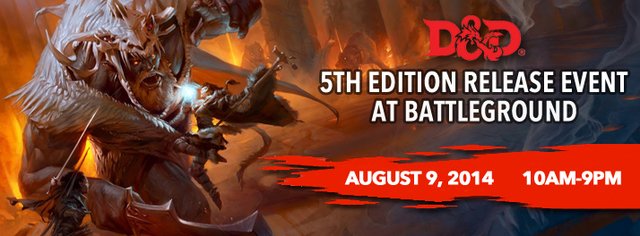
Plus, please don’t forget to join us at Battleground Games & Hobbies on August 9th for the D&D 5th Edition Release event beginning at 10:00 AM and celebrate the release of the brand new Player’s Handbook!
Tags: 5th edition, D&D, D&D Next, Dungeons & Dragons, New Release, Next, Player's Handbook, Wizards of the Coast
Posted in Blog, Board Games, Dungeons & Dragons, Events, Featured Post, Role-Playing Games, Store Related | No Comments »
« Previous Page|Next Page »
© Copyright 2012 Battleground Games & Hobbies
Designed by

contact@battlegroundgames.com | (781) 261 - 9640

Social: